
You searched for the cost per lead for builders. You got a number, probably about 165 with a pound sign on it. Ignore it: it is a United States search advertising median in dollars, republished here with the symbol swapped and no conversion applied.
We went looking for a UK figure with a stated method and sample size. We could not find one. So this article does the next best thing. It sets out what the UK platforms actually charge, what they will not publish, and how to work out the ceiling your own business can afford. That range is the honest answer.
Key Takeaways
- No published UK cost per lead benchmark for trades states its method and sample size. We looked.
- The figure circulating on UK pages is a United States search advertising median in dollars. There is no UK equivalent behind it.
- Rated People, Bark, MyJobQuote and TrustATrader publish no price at all before signup.
- Cost per booked job decides profit, not cost per lead. The two are usually several times apart.
The short answer: there is no single UK figure
No credible single number exists. UK ranges do circulate and they vary widely by trade, but the ones we could find state no method, no sample size and no date range, which makes them somebody’s estimate rather than evidence. We are not going to repeat them here as fact.
What does exist is published mechanics. MyBuilder says its fees “can start from £7”. Checkatrade publishes monthly plan prices. Rated People and Bark publish how many trades can buy the same enquiry, but not the price. Set those against your own job values and win rate and you get a defensible range. Yours will differ from the builder in the next county, because your inputs differ. It is the first sum we run for any building or home improvement firm we take on.
What the UK platforms charge, and what they will not tell you
Two UK platforms publish real prices. Four do not, and that is the more useful finding.
Checkatrade publishes Free at £0 a month, Approved at £30 and Growth from £59, with Growth working by picking your postcode areas and a yearly lead volume for a fixed monthly cost. Checkatrade Pay fees run 1.29% to 1.79%, and the site states “48,000+ quality trades”. MyBuilder charges no joining fee and no membership fee. You pay only when a homeowner shortlists you, the fee varies by job criteria and “can start from £7”, and it is shown before you respond and never adjusted afterwards.
Then the numbers stop. Rated People prices leads by job size and complexity, location, the homeowner’s hiring stage and local trade demand, fixed once the lead is live; its Unlimited plan covers jobs budgeted at £4,000 or below for a flat monthly fee that is not published. Bark sells credits with a one off charge per introduction and no commission, credits valid three months, prices not shown before signup. MyJobQuote prices jobs in credits that expire after six months, pay as you go or optional monthly subscription, with all prices withheld until you create an account. TrustATrader takes a non refundable annual subscription in advance that cannot be cancelled inside the twelve month term, and does not publish the fee.
Read that as a pattern rather than six separate quirks. You cannot compare four of these on price without handing over your details.
How many other trades get the same lead?
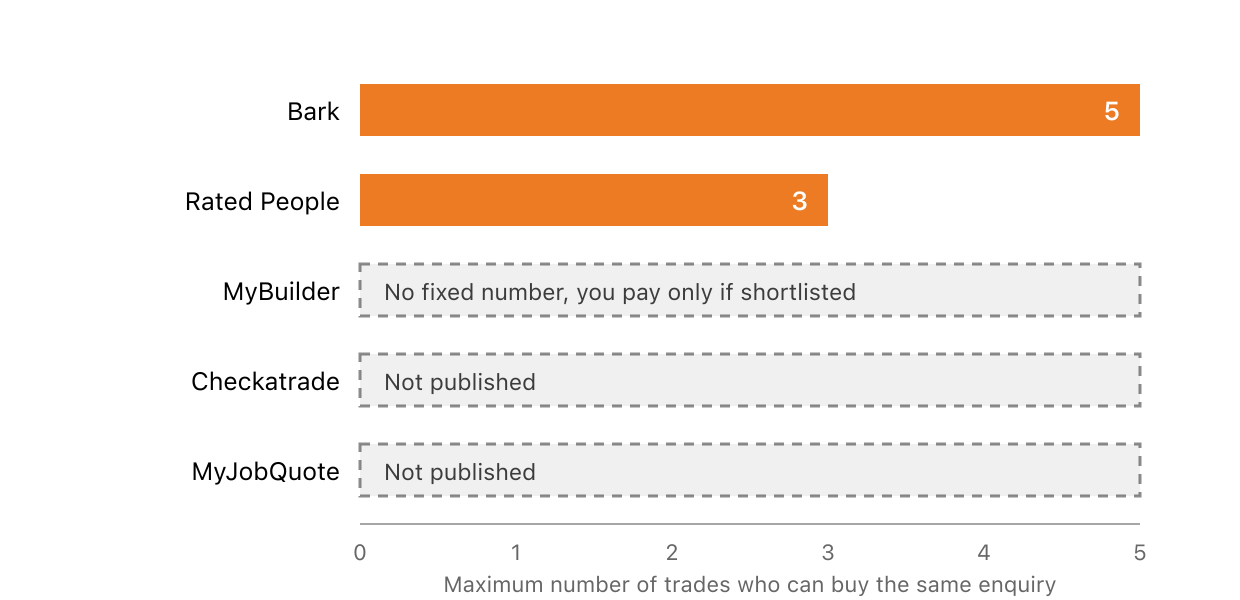
Two platforms publish a cap. The rest say nothing.
Bark’s terms, updated 5 September 2025, state at clause 2.5(a) that a maximum of five Professionals will contact a customer who submits a Bark without selecting a specific professional. Rated People states a maximum of three tradespeople can buy the same lead. MyBuilder sits in a different category, because payment is triggered by the homeowner shortlisting you. Checkatrade and MyJobQuote publish nothing.
That drives your real cost more than the headline fee does. A £10 lead shared with four rivals and a £25 lead shared with two are not the same purchase.
Cost per lead for builders is the wrong number to judge
What a booked job costs is the number that decides profit, and the gap between that and the lead price is wider than most builders expect.
Work it through with round numbers, illustrative rather than measured. Buy ten leads at £35 each and you have spent £350. Six never answer, or turn out not to be the job you do. You quote three of the four left and win one. That single job carries the cost of all ten leads, so it cost you £350 to win, not £35.
Nothing in the advertised price tells you that. The sum that does is your lead fee divided by the share of leads that become signed work. Run it on the prices you are paying now and you will usually find the number is several times what you thought you were spending.
What has a trades lead actually cost us?
On one of our construction campaigns, running on Meta, it worked out at under £18 a lead, and we want to be careful about how far that travels.
Force One Homes spent £285 on initial Meta ad spend across a six week campaign. That produced more than 16 leads and a pipeline worth over £1 million, with the first job won at seven weeks. Mat Boyd, Director, is quoted by name on the Force One Homes case study. £285 across more than 16 leads is under £18 each.
That is one campaign, for one client, on one kind of job in one area, over six weeks. It is not a benchmark, and we would not quote it to another builder as a price to expect. It does show a small budget aimed narrowly can produce enquiries worth having, as it did for Ark Construction, with over £350,000 of projects in the pipeline and its six figure project enquiries.
The sum to do before you spend anything
Work out your ceiling from your own numbers first. Then any lead price is a yes or a no before you pay it.
You need three inputs: your average job value, your gross margin on that job, and the share of quotes you win. Then decide how much of that margin you will spend to win the work.
What follows is illustrative modelling with invented inputs, not a statistic or a market average. Say your average job is £8,000 at a 25% gross margin, so £2,000 of margin. You quote half the leads that arrive and win one quote in four. That is eight leads per job. If you will spend a fifth of the margin on winning work, that is £400 a job, and a ceiling of £50 a lead.
Run it with your own figures. If your ceiling comes out at £22, a £35 lead shared with four other firms is not a pricing question. That ceiling is also what decides how we set up and measure paid campaigns.
What actually moves the number you pay?
Three things move your cost per lead more than platform choice does: what you advertise for, how much the form asks, and how fast you ring back.
Job type and area set the floor. A full house extension in a wealthy commuter town costs more than gutter repairs across a rural county, because more firms are bidding for the same homeowner. Narrow the area to where you will genuinely travel and the number usually improves.
Form length filters. A form asking name, email and phone takes four seconds and collects people who invested four seconds. Adding job type, postcode, timescale and rough budget raises your cost per lead and removes the calls that go nowhere.
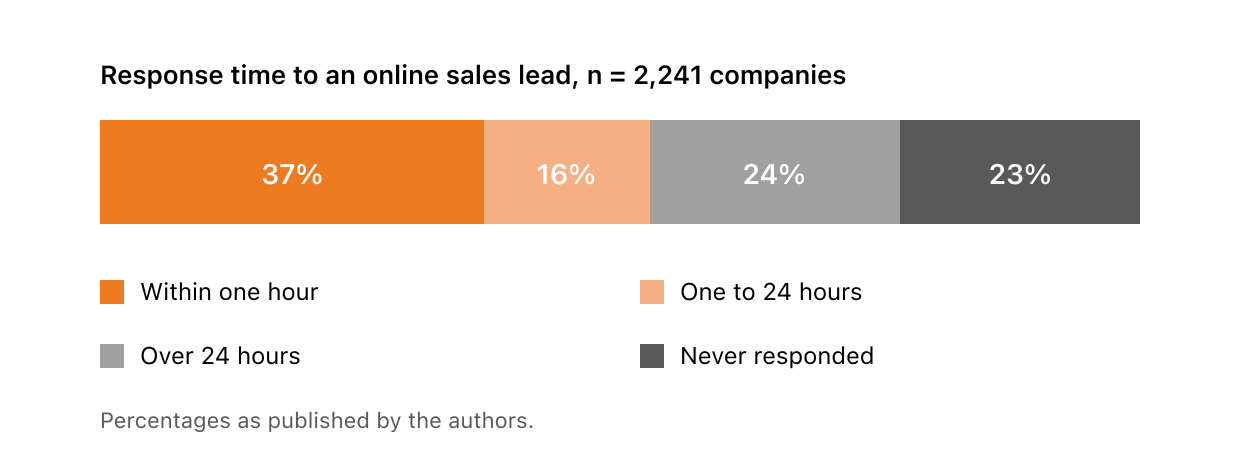
Speed matters too, though this evidence needs handling with care. The 2007 Lead Response Management study by Dr James Oldroyd found the odds of qualifying a lead were 21 times greater when contact came within five minutes rather than 30, across six companies, more than 15,000 web generated leads and over 100,000 call attempts. Three caveats. It was produced with InsideSales.com, a vendor selling lead response software. Six companies is a small sample. Both that study and the Harvard Business Review follow up measured United States business to business inside sales teams, not a UK builder returning a call from a roof. Treat it as directional evidence about speed, not a measured fact about trades. The “391x” and “100x” versions circulating online trace back to neither document.
Work out your ceiling with us
If you want that sum run properly against your own job values, margin and win rate, we will do it with you and tell you straight whether paid advertising beats the platform fees you are paying now. We would rather talk you out of a channel than sell you one that cannot clear your ceiling.
Frequently asked questions
Is £165 a realistic cost per lead for a UK builder?
Not as a UK figure, because it is not one. It comes from United States search advertising campaigns and is quoted in dollars. UK ranges are published and they differ a good deal by trade, but none we could find states a method, a sample size or a date range, so treat them as estimates rather than evidence. Work out your own ceiling from your job values, margin and win rate, and judge any quoted price against that.
Is Checkatrade or MyBuilder cheaper?
They charge on different models, so it depends on your volume. Checkatrade runs a monthly subscription at £0, £30 or from £59 by plan. MyBuilder charges nothing to join and nothing monthly, taking a fee only when a homeowner shortlists you, which “can start from £7”. A quiet month costs you nothing on MyBuilder and the full subscription on Checkatrade.
Why will these platforms not publish their prices?
They do not say. What we can report is the pattern: Rated People, Bark, MyJobQuote and TrustATrader all withhold figures until you register or enquire, which makes comparison impossible unless you sign up to all four.
How many leads do I need before I can judge a campaign?
Enough to see booked jobs, not enquiries. If you quote half your leads and win one in four, a single job takes about eight leads, so ten leads tells you almost nothing. what we do for building and home improvement firms covers how we set that measurement up.
The honest verdict
There is no UK cost per lead figure for builders that we can point you to with a straight face. What there is: two platforms publishing real prices, four withholding them, and two publishing how many rivals get the same lead.
Your own numbers beat all of it. Average job value, margin, win rate, and the share of margin you will spend to win work. That gives you a ceiling, and a ceiling turns every lead price you are quoted into a straightforward yes or no. If you would rather not run it alone, talk to us about lead generation for trades.