
In the last week of 2025, Checkatrade’s own Home Improvement Index reported that demand for home improvement work had fallen from the highs seen after lockdown, that the housing market had slowed, and that the result was more competition for work and lower costs for consumers (Home Improvement Index, Q4 2025 edition, read 28 August 2026; that page rolls forward each quarter).
Read that again as a builder who pays for enquiries. More trades, chasing fewer jobs, at lower prices, through a queue you rent by the month. That is the model working exactly as designed, and it is why, when building firms ask us for a Checkatrade alternative for builders, we tell them to spend the same money putting video of their own work in front of homeowners instead.
Key Takeaways
- Checkatrade’s own index is built on close to 4 million job enquiries a quarter, and its Q4 2025 edition reports average building job costs down 14% in a year and 25% from their 2023 peaks. More competition, smaller jobs.
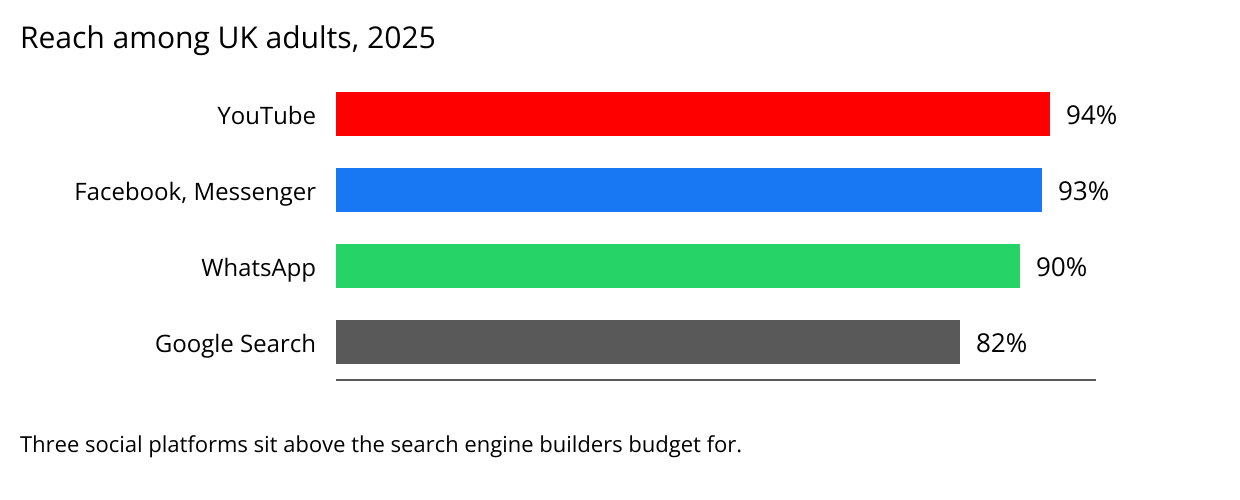
- Social platforms reach more UK adults than Google Search does. Ofcom puts YouTube at 94% of adults and Facebook with Messenger at 93%, against 82% for Google Search.
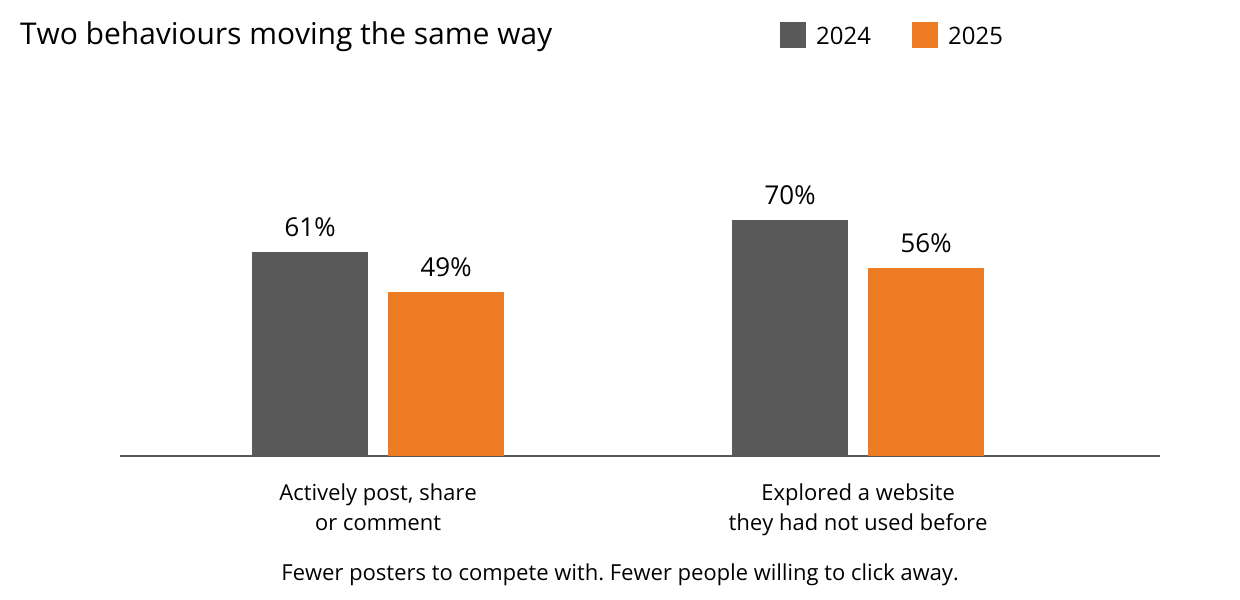
- Only 49% of UK adult social media users still post, share or comment, down from 61% in 2024. The feed is fuller of watchers and emptier of posters than it was.
- UK adults give YouTube 51 minutes a day and Facebook with Messenger 43 minutes. Attention has moved to video, which is why the video is the part you cannot cut.
- Directories still win emergency work. If a pipe bursts, nobody scrolls.
In this article:
- What most builders are told to do
- Three things a rented enquiry cannot do for you
- The audience is not where the enquiries are sold
- Attention moved to video, so the work has to be filmed
- The Checkatrade alternative for builders
- A six week start
- Where this does not work
- Frequently asked questions
- The honest version
What most builders are told to do
The standard advice is sound as far as it goes. Get listed, get vetted, get reviewed, and let a platform that homeowners already trust hand you enquiries you did not have to earn.
That advice earned its place. Checkatrade’s Home Improvement Index is built on data from close to 4 million job enquiries every quarter, more demand than any single building firm could generate alone. Homeowners rate the experience well: 4.6 out of 5 on Trustpilot across 85,627 reviews, with 85% giving five stars.
For a builder in their first year, with no photographs, no reviews and no local following, that is a fair trade. You are buying borrowed credibility and it is worth paying for.
The problem is year three, when you have the credibility yourself and are still paying rent on somebody else’s.
Three things a rented enquiry cannot do for you
A rented enquiry is a transaction, not an asset. It buys you one conversation and nothing else, and three consequences follow.
You cannot budget against a price you are not shown. Checkatrade does not publish a rate card. Its sign up process asks you to pick your trade, then the postcode areas you want to work in, then the number of leads you would like to receive each year, and only then quotes you a monthly cost. The pricing page is a five step form, not a price list. Whatever the number turns out to be for a bricklayer in Bolton, you cannot compare it to anything until you have committed to finding out. We have covered what a builder should actually pay per lead separately, including how to work out your own ceiling before you take that call.
The enquiry is shared, and the market it is shared into is getting tighter. Checkatrade does not publish how many members receive the same job enquiry, so we will not put a number on it. What the company does publish is the direction of travel: average costs for jobs in its building category fell 14% in the year to Q4 2025, and 25% from their 2023 peaks, an average drop of around £2,000 a job. Its own explanation names demand falling and competition for work rising. Cheaper jobs, split more ways, is the wrong direction for a fixed monthly fee.
That is not only Checkatrade’s reading of its own market. The Federation of Master Builders found in its State of Trade Survey for the second half of 2025 that while workloads among small builders held up, enquiry levels softened, and that policy changes and rising overheads were denting confidence going into 2026. Two independent sources, both pointing at the enquiry side as the pressure point.
Nothing accrues. Stop paying and the enquiries stop that month. Three years of membership leaves you with the same standing start you had on day one: no audience, no footage, no list, no recognition in the postcodes you work. Compare that with three years of video of your own work, which sits there and keeps earning.
The audience is not where the enquiries are sold
Here is the part that surprises builders. The platforms selling you enquiries are smaller, in pure reach, than the platforms you are ignoring.
Ofcom’s Online Nation 2025 report puts YouTube in front of 94% of UK adults and Facebook with Messenger in front of 93%, with WhatsApp at 90%. Google Search reaches 82%. Alphabet and Meta between them account for more than half of all the time people in the UK spend online.
Then there is a shift almost nobody in the trade has noticed. UK social media use is turning passive. Ofcom’s April 2026 study of adult media use found that 49% of adult social media users actively post, share or comment, down from 61% the year before, and that the share who explored new websites fell from 70% to 56%.
Both halves of that matter to a builder, and they pull in the same direction. Fewer people posting means less competition for the same attention, so a well made video of a finished extension has a clearer run than it did two years ago. Fewer people willing to click off to a new website means the selling has to happen inside the feed, in the video itself, before anyone taps anything.
Attention moved to video, so the work has to be filmed
If the selling happens inside the feed, the question becomes what holds someone there. Ofcom’s numbers answer it. UK adults give YouTube an average of 51 minutes a day, before you count anything watched on a television set. Facebook with Messenger takes 43 minutes and Instagram 20. Among adults aged 18 to 34, TikTok alone takes 49 minutes a day.
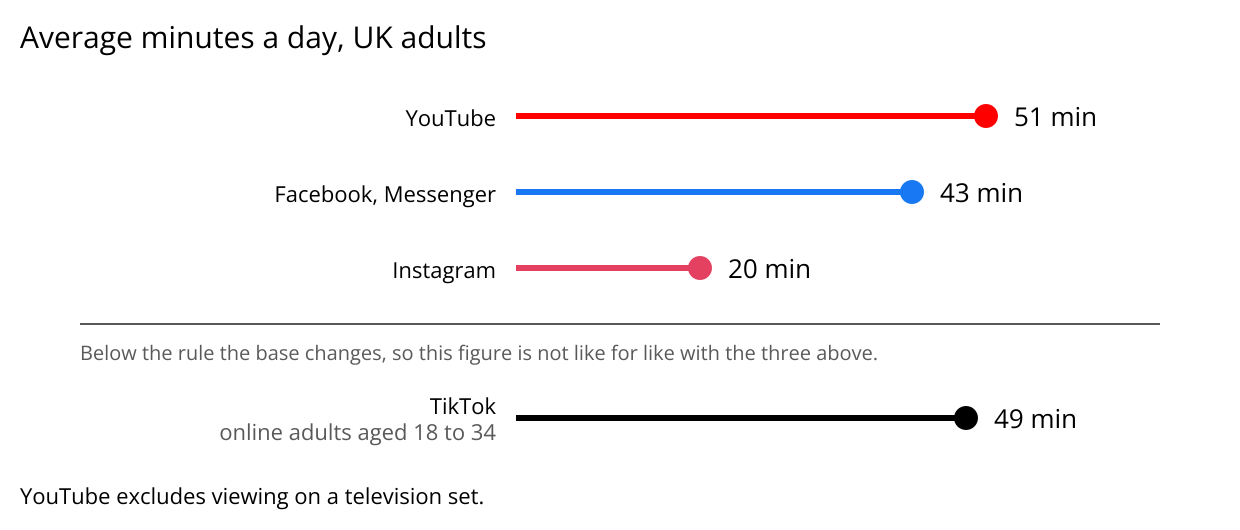
The surfaces taking the most time are the ones built for video. That is the whole argument for filming, and it is why we treat video and photography as the first job on a trades account rather than a nice extra at the end.
One more number is worth sitting with. When IronmongeryDirect surveyed 500 UK tradespeople through The Leadership Factor, 47% said a social presence helped them win more work and 85% said they were not sure how to use it effectively (reported by BDC Magazine, fieldwork November 2020; IronmongeryDirect no longer lists the original release). It is nearly six years old, so treat it as a signal rather than a current figure, and read it in the direction it points: nearly half the trade had already seen social win them work, and a large majority did not know how to make that happen. The gap was never belief. It was execution.
The Checkatrade alternative for builders
Paid social advertising, built on video of your own finished work, in the postcodes you want to work in. That is the replacement, and the order of those words matters.
Organic posting alone will not do it. It is capped by however many people already follow you, which for most building firms is a few hundred locals and a handful of suppliers. Paid distribution removes that ceiling: the video that would have reached 300 people reaches every homeowner in the postcodes you choose.
The video is the part that cannot be cut, and it is where most trades advertising falls over. Four principles hold it together.
Film the job, not an advertisement. The extension going up, the first coat going on, the reveal on the last day. Homeowners are buying an outcome they cannot picture yet, and footage of a real job in a street that looks like theirs does that job better than any claim about quality or reliability.
Shoot it properly. A shaky clip in poor light reads as a small operation with no standards, whatever the workmanship was actually like. This is the difference between video that costs you money and video that makes it.
Make the enquiry harder, not easier. A form that takes four seconds collects people who put in four seconds of thought. Ask the job, the postcode, the timescale and the rough budget. We have covered this at length elsewhere, and in the accounts we take over it is the most common reason a builder had concluded that paid social does not work.
Answer the same day. Every hour you take, the enquiry cools and a competitor closes.
Own the footage and you own the asset. Turn the advertising off in a quiet month and the video is still yours, the audience is still there, and the phone still rings from people who saw you in June.
Set the two models side by side and the trade becomes obvious.
| Rented enquiries from a directory | Paid social built on your own video | |
|---|---|---|
| Price you are quoted | Not published. Set by your trade, your postcodes and the annual lead volume you pick, and shown only inside the sign up process | Set by you. A daily budget you can change any day |
| Who else receives it | Shared with other members. The number is not published | Yours. The enquiry arrives with you |
| Best at | Emergency and urgent work, where someone is searching right now | Planned, higher value work, where someone decides over weeks |
| Speed to first work | Days. You are buying a queue that already exists | Weeks. Eight to twelve before the numbers mean anything |
| What you keep if you stop paying | Nothing. The enquiries stop that month | The footage, the audience and the recognition |
A six week start
Six weeks is a realistic run from nothing to a campaign with real numbers on it.
- Week one, pick the work you want more of. One job type, one radius. Loft conversions within twelve miles beats “building work” everywhere. About an hour of honest thinking.
- Week two, film one live job properly. A half day on site with a camera gets you a reveal video, three short cuts and a set of stills. That footage feeds a month of advertising.
- Week three, build the enquiry route. One landing page or one form, four qualifying questions, and a phone that gets answered. Half a day.
- Week four, launch small and narrow. Tight postcodes, one job type, a budget you would not miss. You are buying information, not jobs, in week four.
- Weeks five and six, cut what is clearly not working and put the money into what is. At six weeks you are pruning on early signals, enquiry quality and cost, not judging the channel. That judgement needs booked jobs, and booked jobs take longer.
Track four numbers and nothing else: enquiries, quotes sent, jobs won and total spend. Divide spend by jobs won and you have the only figure that matters. Expect the first month to look mediocre and the third to look obvious. We tell building firms to plan for the pattern settling somewhere in weeks eight to twelve rather than in week two, because a building job has a long decision behind it.
Want the short version of this run for your own patch? Tell us the job type and the postcodes and we will tell you whether it is worth filming.
Where this does not work
Emergency trades should keep the directory. If a pipe bursts at seven in the morning nobody opens Instagram. They search, they ring the first three results and they book whoever answers. That intent lives on Google and in a directory listing, and no amount of video will catch it.
The same applies if you are genuinely new. With no completed jobs to film and no reviews, borrowed credibility is the faster route for a year or two.
And paid social done badly is worse than not doing it. Cheap footage pointed at a four second form will fill your week with people who wanted a price for a job you do not do. That is not the channel failing. That is the setup failing, and it is fixable.
Frequently asked questions
Should I cancel Checkatrade tomorrow?
No. Run both while you build the video side, then judge them on the same measure: total spend divided by jobs won. Most membership plans run on a fixed twelve month term anyway, so you have time to gather the comparison honestly rather than switching on a hunch.
How long before video advertising brings work in?
Plan for eight to twelve weeks before the numbers mean anything. A building job has a long decision, and the homeowner who saw your loft conversion video in September may enquire in November. Judging a trades campaign at three weeks is another common way a builder gives up on one that was working.
I am a builder, not a content creator. What do I actually film?
The jobs you are already on. Wide shot of the site before you start, a few minutes of the work in progress, the finished room with the light coming in. You do not need to talk to camera and you do not need a personality. You need proof. Getting the footage shot properly is work we do on site precisely so nobody has to become a presenter.
Does this replace my website?
No, and it changes what the website is for. With only 56% of UK adult social media users visiting a website they had not used before in 2025, down from 70%, fewer people will click through to browse (Ofcom). The site stops being a brochure people wander around and becomes the place a warm enquiry lands and converts.
The honest version
Checkatrade is not a con. It is a functioning marketplace whose index draws on close to 4 million job enquiries a quarter, and for a builder with nothing to show yet it is a reasonable thing to buy.
It is also a marketplace whose own index reports that demand fell and competition for work rose, in a year when the average cost of a building job on its platform fell by around £2,000, its own published figure. If your only route to a customer is a queue you rent inside that market, you have handed someone else the two things that decide whether you grow: how many enquiries you get and what they cost.
The audience you want gives YouTube 51 minutes a day and Facebook 43, and fewer of them than ever are posting anything themselves. There is room in that feed for a building firm with decent footage and a budget behind it, and the footage keeps working after the budget stops.
If you want that built properly, see how we run paid social for building and home improvement firms, or read what we do across construction and home improvement.