
Before a homeowner rings a builder about an extension, they want to know roughly what it will cost. If your website does not tell them, a national cost table will, and it knows nothing about your area, your spec or your prices. A house extension price guide built from your own finished jobs answers that question for them. The enquiries that come in afterwards already know what they are likely to spend, so fewer of your evenings go on quotes for people who were never going to go ahead.
Homeowners are asking about cost first
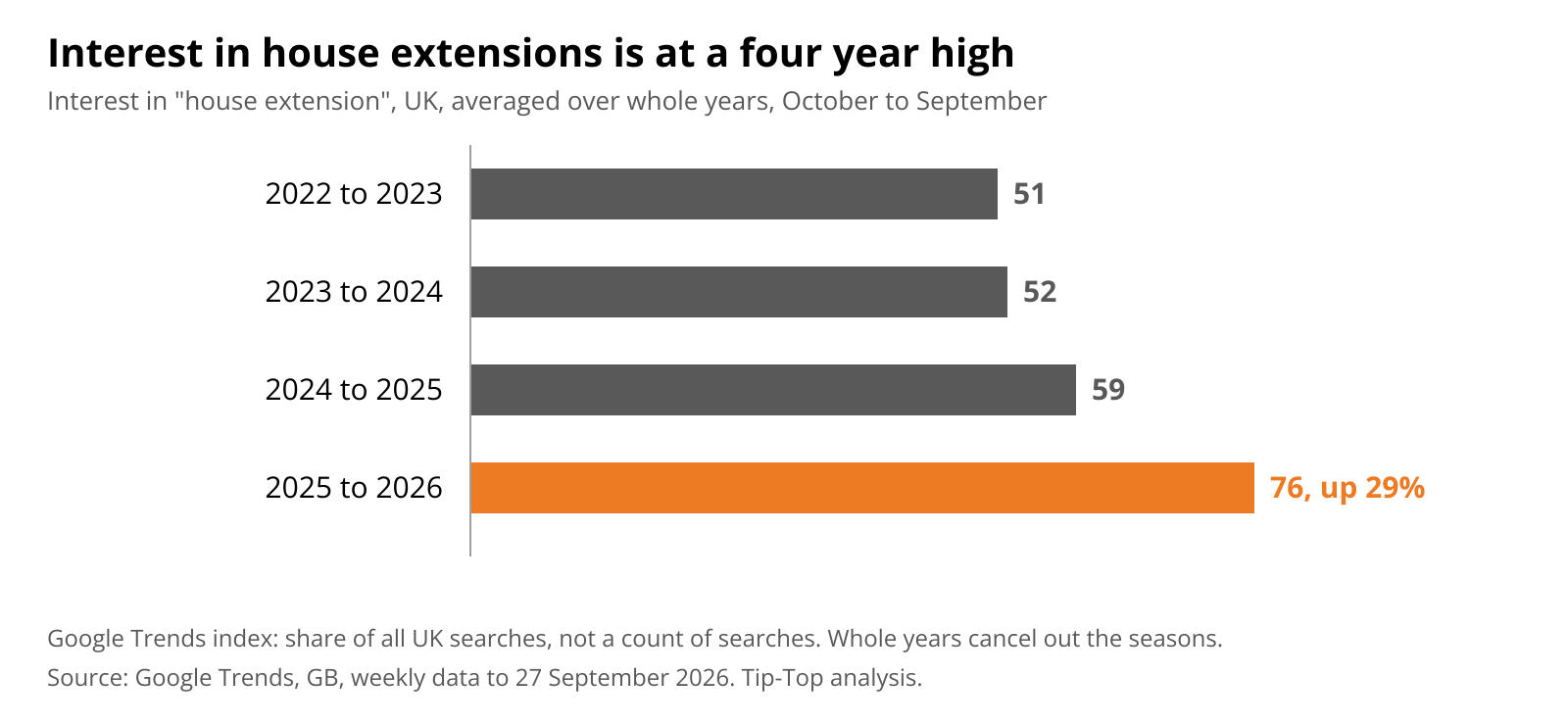
We checked Google’s UK search data on 1 October 2026. Averaged over whole years so the seasons cancel out, interest in “house extension” was 29% higher in the year to September 2026 than the year before, and 49% higher than three years earlier. That is a share of all UK searches rather than a count of people, but the direction is clear.
What those people search for alongside it is cost. The top related searches are “house extension cost”, “extension cost” and “house extension cost calculator uk”. On Google’s five year view, “house extension cost per m2” is one of the fastest rising related searches, up 190%. Homeowners are trying to put a number on the job before they pick up the phone.
They are also working with tighter budgets. The 2026 UK Houzz & Home Report, a survey of more than 1,000 UK homeowners reported by KBB Review, found planned renovation budgets fell to £10,000 from £14,000 a year earlier. 38% of homeowners went over their budget, and 26% started without one at all. Those figures cover renovations of every kind, not extensions alone. Still, they describe a homeowner who wants a realistic number early and often has nobody to ask.
What a price guide wins you
- Enquiries that fit your work. Someone who has read your ranges and still gets in touch has already decided the job is within reach.
- Fewer wasted site visits. The homeowner who wanted a double storey extension on a single storey budget finds out from your website, not from a two hour visit.
- Trust before the first call. A builder who is open about price looks like a builder who will be open about everything else.
- A better first conversation. You start from “we are thinking of the middle of your range”, not “how much roughly?”
How to build your house extension price guide
You already hold the data. It is in your invoices.
- Pull your recent finished extensions. Use the final invoiced price, not the quote, so the range reflects what jobs really came to. Ten to twenty jobs is plenty to start.
- Group them by type. Single storey rear, side return, wraparound, double storey. Homeowners search by type, and the prices differ too much to share one range.
- Work out a price per square metre for each. Divide each job by its floor area, set aside the one or two that were unusual, and take the low and high ends of what is left.
- Say what is included and what is not. VAT, architect’s drawings, planning and building regulations fees, structural engineer, party wall costs, the kitchen, flooring and decorating. Unclear inclusions are where homeowners feel a budget has run away from them, so spell them out.
- Add one worked example per type. “A 4 by 6 metre single storey rear extension in [your town], built to [your finish level], typically comes to between £[your low] and £[your high].” A homeowner can picture that far more easily than a rate.
- Put a date on it and review it twice a year. Material and labour costs move. A dated range looks honest; an old undated one looks careless.
Keep it to ranges. A fixed price on a web page is a promise you cannot keep without seeing the house.
Where to put it so it brings in calls
- Give it its own page, headed with your town: “House extension prices in [your town]”. That matches what homeowners type, including the near me searches people make once they are ready to hire.
- Link to it from your extension service page and your enquiry page, so anyone weighing you up finds it.
- Show a finished job of each type next to its range. Your own real photographs of a completed side return say more than any rate.
- Add a budget question to your enquiry form with bands that match your guide. You will know before you ring back which range they are in.
- Use it in your replies. When an enquiry comes in, send the link with your first message. It sets expectations and gives the homeowner something to share with their partner. Following up quickly matters just as much once they have read it.
Where to start
- Pull your last ten to twenty finished extensions and group them by type.
- Work out a price per square metre range for each type.
- Write down what is and is not included.
- Publish it on its own page with one example per type, and date it.
We write and build these pages for builders as part of our website design and build and copywriting work, from the price page itself to the enquiry form behind it. If you would like us to look at what homeowners in your area see when they search for extension prices, book a free 20 minute strategy call.