
A homeowner planning an extension wants to see one thing before they pick up the phone: work like theirs, done by you. That is what photography for builders marketing comes down to. A real photograph of a real job answers that question in a second. A stock photo of somebody else’s kitchen cannot, however polished it looks.
The good news is that you already produce the raw material on every job. Captured properly once, it keeps working in your ads, on your website and on your Google profile long after the skip has gone.
What a homeowner checks before they ring
The Federation of Master Builders publishes a ten point checklist for choosing a builder. Point three is previous work: the homeowner should have “seen examples of completed or current projects” (FMB, How to choose a builder). Your trade body is telling your customers to look at your photos.
And more of them are judging you on screen first. Research from the FMB and the HomeOwners Alliance, published on 2 June 2026, found that homeowners under 35 are twice as likely as the average to judge a builder on their website and branding: 20% against 9% across all ages (FMB, 2 June 2026). The release gives no sample size, so treat the gap as a direction rather than a precise measure. The direction is clear enough: the people buying their first big project look at what you show them online.
What a real photo proves
A stock image shows that a building can look nice. Your own photo shows three things a homeowner is actually trying to find out.
- You do this kind of work. A rear extension on a 1930s semi, a garage conversion, a loft with a dormer. The closer your photos are to the job they are planning, the shorter the leap of trust.
- You are a real firm. Your van, your scaffold, your team in branded kit. Anyone can put a picture of a smiling man in a hard hat on a website, and homeowners know it.
- You finish properly. The details close up: the brick match, the soffit line, the tiling round the window. That is where good work shows and where a stock photo has nothing to say.
There is a second gain. The same stock images turn up on any number of trade websites, so they make you look like everyone else. Your own jobs are the one thing no rival can copy.
The drone shot, and what it shows
This is the image at the top of our Ark Construction case study. It is a large rear extension mid build, roof frame up, scaffold round it, a worker in hi vis on the deck, the neighbours’ gardens either side.
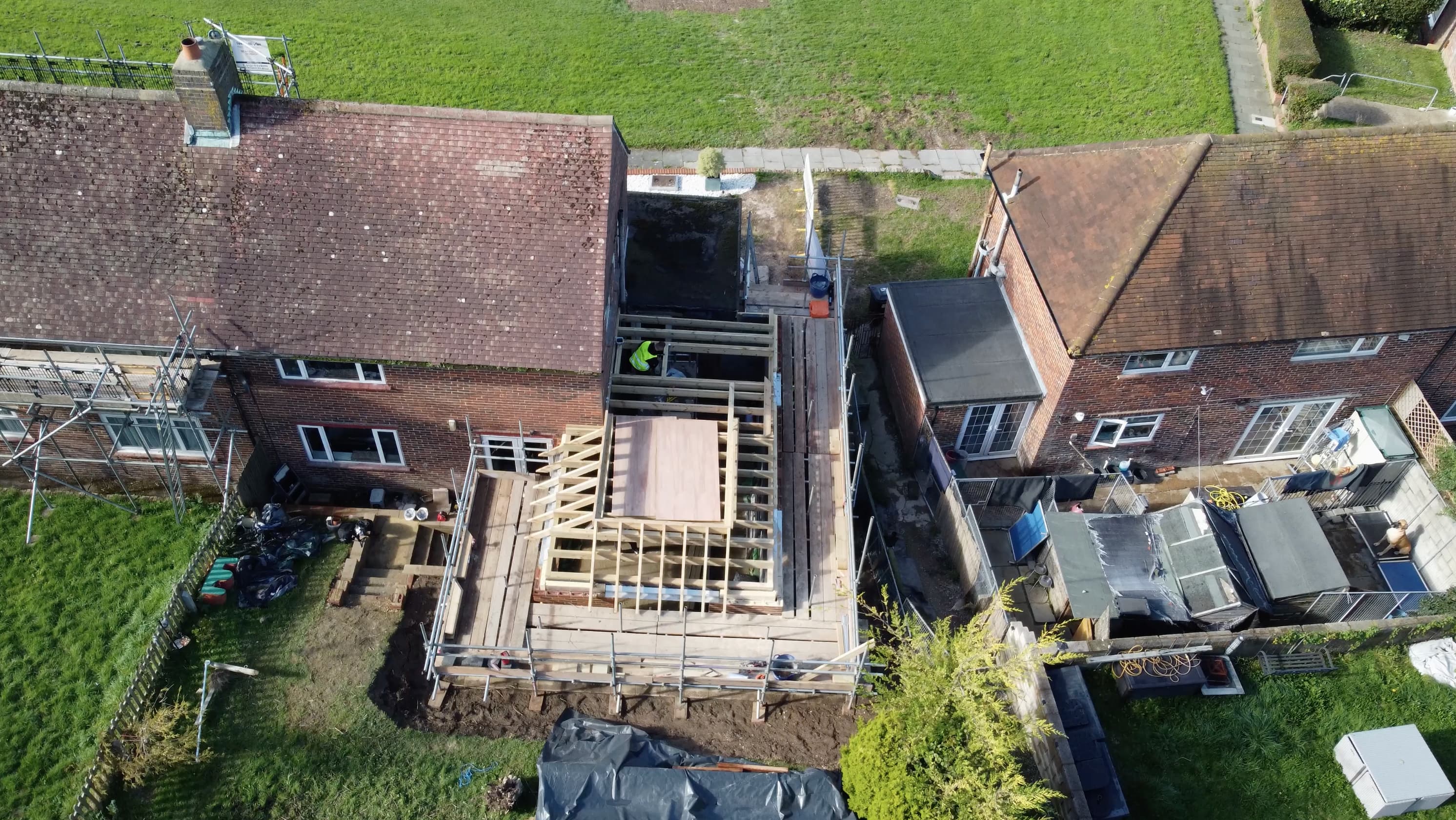
Nothing about it is staged, and that is why it works. A homeowner with a similar house can picture their own garden in it. They can see the scale of what Ark takes on. No library image can do that, because no library image is of a job Ark built.
Ark is a premium firm doing extensions, renovations, garage and loft conversions. We came on site and filmed their completed and in progress builds, and that footage helped prospects arrive better informed and ready for a serious conversation. Ark now regularly quotes on residential projects, with several valued at £350,000 or more moving through the pipeline. In fairness to the numbers, the photography did not do that alone: it ran alongside Facebook and Instagram ads and a CRM that handled every enquiry. What it did was make the ads believable.
LMP Developments tells the same story. Their workmanship was already strong, but their previous marketing did not show it. Once video of their real projects went into the campaigns, enquirers could see the quality of work before they got in touch, and the calls that came in were warmer and better matched to the jobs LMP wanted.
One shoot, three places it works
The point of planning a shoot properly is that the same material feeds everything.
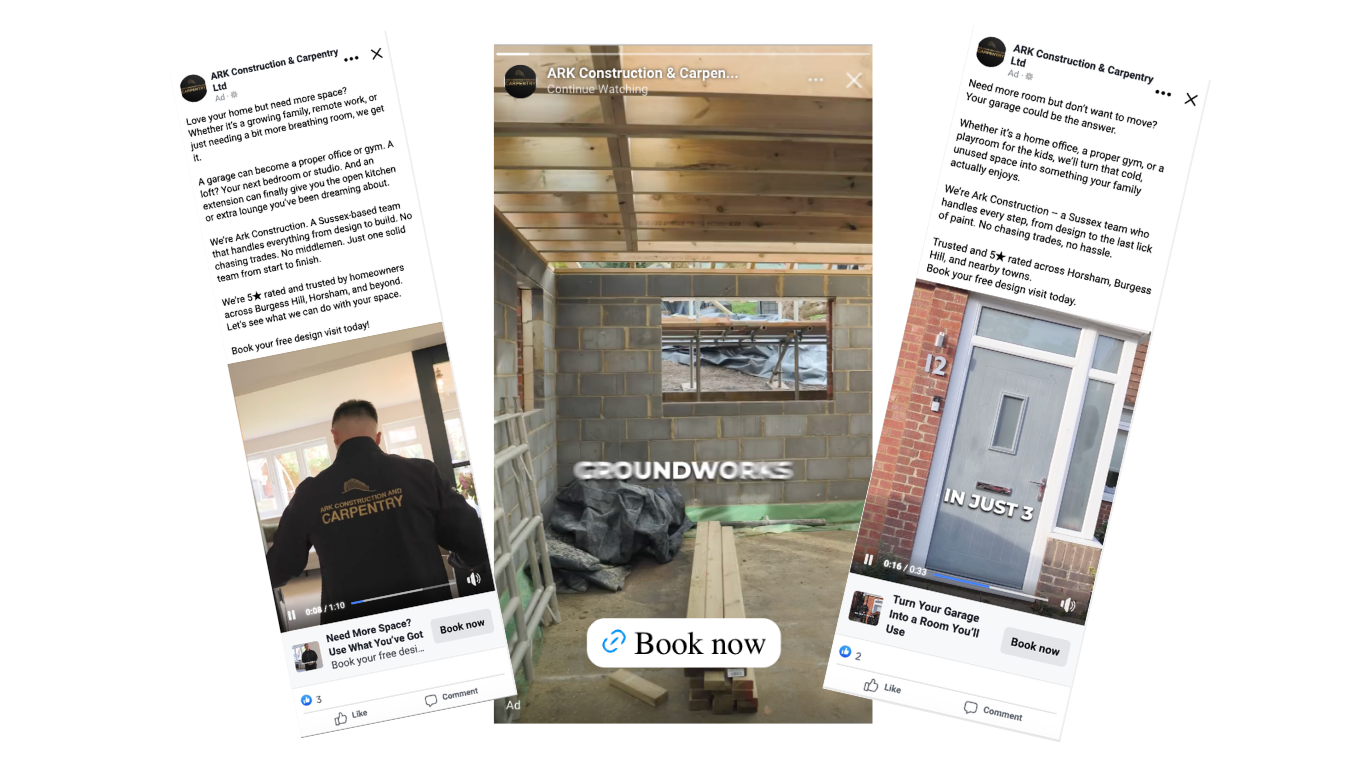
Your ads. Facebook and Instagram ads built on real footage look like what they are: a local firm showing its own work. Here are three of Ark’s, each using their own site.
Your website. A page per project, with the before, the build and the finish, is the “examples of completed or current projects” the FMB tells homeowners to look for. Put it where an ad sends people, so the proof is one tap away.
Your Google Business Profile. Google’s own guidance is that you can “show customers what you offer and tell the story of your business with photos and videos” (Google Business Profile Help). Upload a few from every shoot and your profile stays current without extra work. Our guide to Google Business Profile for builders covers the rest of it.
Planning a shoot that lasts
A shoot that keeps paying back is planned around the job, not squeezed in at the end.
- Book it in stages. Groundworks, frame up, roof on, finished. One visit at handover gives you a nice room; four give you the story of how it got there, which is what a homeowner planning their own build wants to see.
- Get the before. It is the easiest shot to forget and the one that makes the after mean something.
- Go wide and go close. The whole extension from the garden or the air, then the details: brickwork, joinery, finishes.
- Shoot both ways round. Wide frames for your website, upright for Facebook and Instagram stories and reels.
- Put your people in it. Branded workwear, your van on the drive. It tells the viewer who did the job.
- Ask the homeowner first. Get permission to photograph and to use the images, and keep their house number and anything personal out of frame.
For the shots you take yourself between visits, what to film on a job has a list that works on a phone.
What we do
We plan and run photo and video shoots for building firms, on site, and turn the results into Facebook and Instagram campaigns and website content that all draw on the same real work. One shoot, captured properly, and every place a homeowner checks you shows the jobs you actually do.
See our video and photography service, read how we run social media advertising for trades, or get in touch.