
You are on site anyway. The scaffold goes up, the steels go in, and by Friday the room looks nothing like it did on Monday. That sequence is the raw material for a year of advertising, and capturing it costs under a minute a day.
The useful question about video marketing for builders is what to point the phone at. So here is the shot list: seven clips, when to get each one, and what each one does once it reaches a campaign.
The constraint that shapes the whole list
Nobody is going to stop work to make a film. Any shot list that assumes otherwise gets ignored by the second week.
So every clip below is between five and sixty seconds, handheld on a phone, and taken at a moment that already happens on the job. No lighting, no second take, no crew. The only real skill is remembering to press record, which is why this list is worth pinning up inside the van.
The seven shots
| Shot | When to get it | Roughly | What it does |
|---|---|---|---|
| The before walkaround | Day one, before anything moves | 30 to 60 seconds | Gives every later post something to compare against |
| The strip out | As the skip fills | 10 to 15 seconds | Holds attention in a feed, because people watch things come apart |
| The structural moment | Steels in, blockwork up, roof on, slab poured | 10 seconds each | Shows you do the difficult part, not only the finish |
| The craft close up | Whenever a detail comes out well | 5 to 10 seconds | Convinces the careful homeowner who is comparing three quotes |
| The reveal | Handover day, tidy, lights on | 20 to 30 seconds | The payoff, and the still that becomes your ad image |
| The customer’s own words | Handover day, while they are pleased | 20 to 40 seconds | Proof of a kind you cannot write yourself |
| The team at work | Any ordinary moment | 10 seconds | Makes the firm look like people rather than a logo |
Seven shots across a job that runs six weeks is not a filming schedule. It is about a dozen times you take the phone out of your pocket.
Getting them in a state you can use
Three habits separate footage that cuts together from footage that stays on a phone.
Film upright. Facebook and Instagram fill a phone screen with upright video, so that is the sensible default. Turn the phone sideways only for a wide establishing shot you want on your website or on YouTube, and take both when the moment is worth it.
Get closer than feels natural. A phone microphone picks up wind, a radio and the road long before it picks up your voice. Standing two feet closer fixes more than any app will.
Hold still and count to ten. A steady shot, or one slow pan, can be cut into almost anything. Footage that swings about while you talk over it cannot be used at all.
The one worth setting a reminder for
The before walkaround is the shot people forget, and it carries the most weight later.
A finished kitchen on its own is a nice photograph. The same kitchen alongside sixty seconds of the dark, tired room it replaced is an argument. Homeowners are careful with money at the moment, and they are choosing between firms who all show finished work. The before shot is the one that shows how far you moved it.
It takes under a minute, and it can only be taken once. Film it before the first tool comes off the van.
What the footage turns into
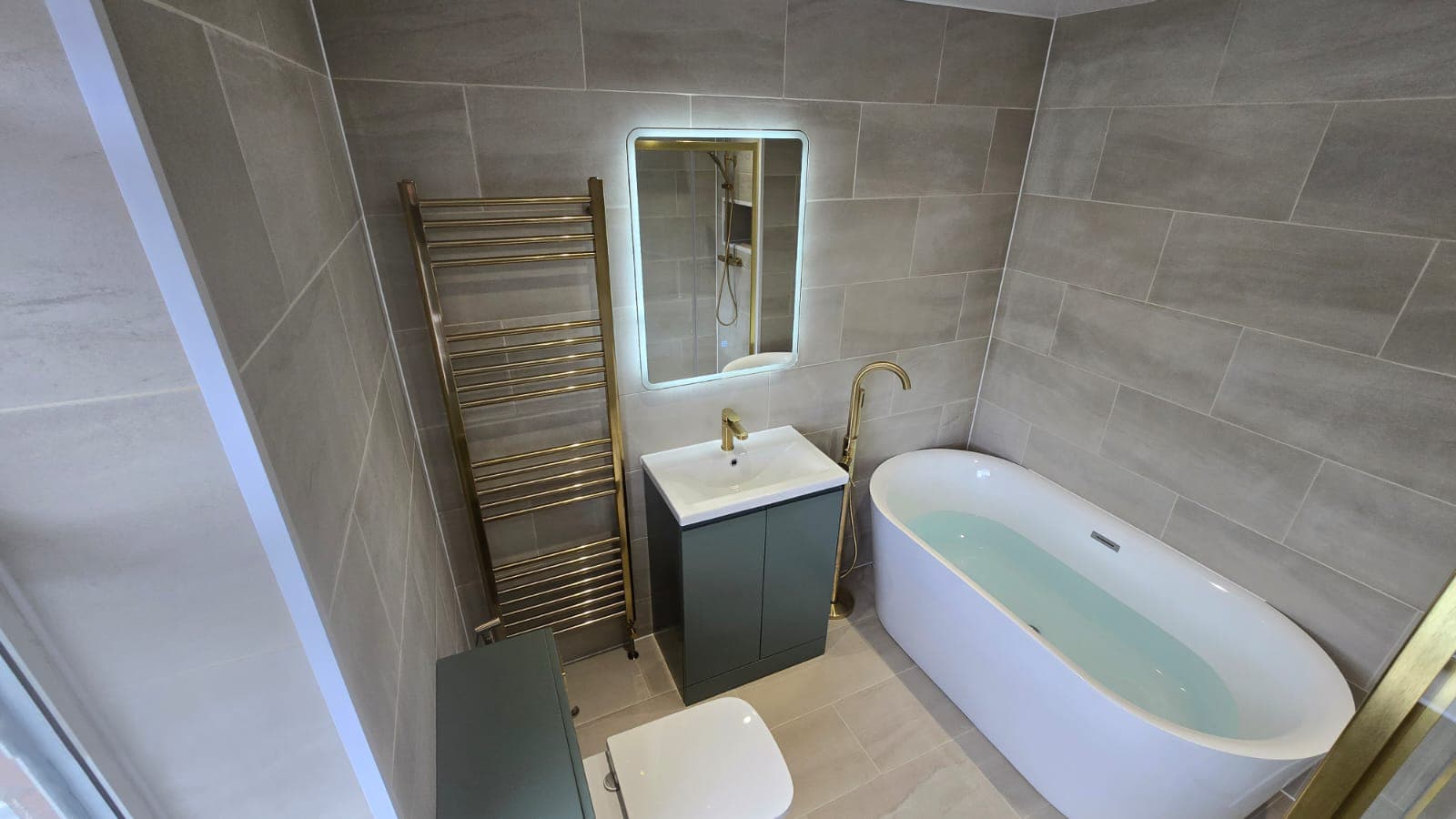
One job filmed this way produces enough material for months: several short posts, a before and after that gets shared, a still for the advert itself, and a clip of the customer saying the job went well.
None of that needs a production crew. Video marketing for builders comes down to the footage existing, and then somebody cutting it, captioning it and putting money behind the pieces that perform. The second half is where it usually stalls: a camera roll full of decent clips and nobody with a spare hour to sort them.
That second half is what we do. Video and photography covers the shoots that are worth booking properly, the drone shot over a finished extension and the case study film. Paid social is where the short clips go to work. The enquiries they bring in then have to be answered quickly to become jobs, which is a separate discipline and one we have written about already.
Start on the next job
Pick one. Film the walkaround before you start, three clips a week while it runs, and the reveal on the day you hand over. That is one job’s worth of material, and it is enough to find out whether it brings you enquiries.
If you would sooner hand the footage over than edit it, get in touch and we will tell you what can be done with what is already sitting on your phone.