
Right now, most SME builders are still busy. Jobs booked months ago are running, the diary is full for the next few weeks, and turnover this year is ahead of last year. If you judge your business by how the phone rings on site, everything looks fine.
Look at the enquiries feeding that work, rather than the work itself, and the picture is less comfortable. Builders enquiries dropping in relative terms, not in absolute numbers, is what the trade’s own data shows for the second half of 2025, and it is worth understanding now, while the current backlog is still hiding it.
What the Federation of Master Builders actually found
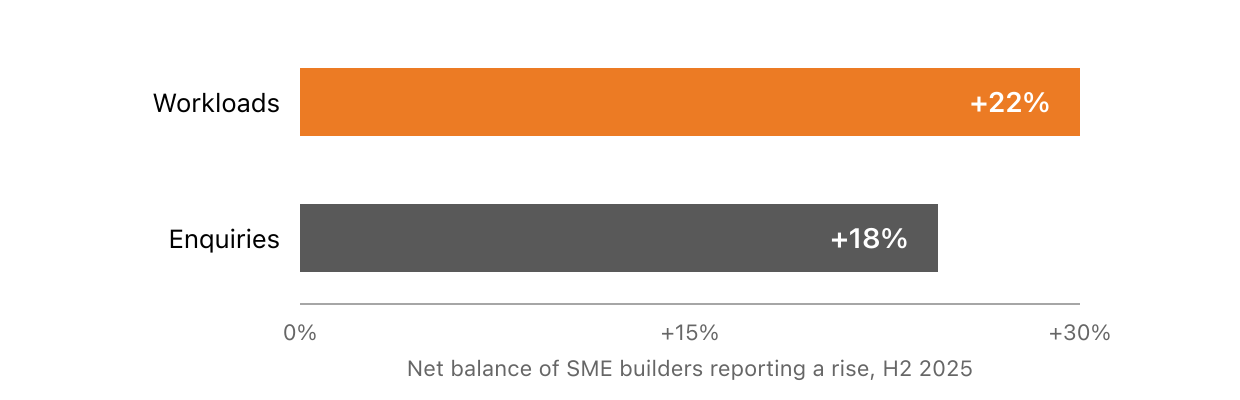
The Federation of Master Builders surveys SME builders twice a year. Its State of Trade Survey for H2 2025, based on 493 firms, reports a net balance of +22% for workloads and +18% for enquiries. Both are net balances, the share of firms reporting a rise minus the share reporting a fall, so both are still positive. Workloads are not falling and enquiries are not falling either.
What the survey does say in its own words is that growth “has slowed compared with H1”, and that momentum has eased as rising costs, skills shortages and wider economic uncertainty weigh on firms. The gap between the two figures above is the sharpest way to see that: enquiries are growing, just not keeping pace with the workloads they are supposed to feed.
The same survey found that 49% of firms reported job delays linked to a shortage of skilled tradespeople. That matters here because it explains why the gap does not feel urgent yet. When a job takes longer to deliver because you cannot get a second fitter, a thinner flow of new enquiries is invisible. The diary still looks full. It is only once the current jobs finish that a quieter front end becomes a quieter site.
Why the enquiries themselves have changed shape
Houzz’s UK & Home 2026 study gives the homeowner side of the same story. 49% of UK homeowners renovated in the last twelve months, close to the 51% the year before, so the appetite to do work has barely moved. What has moved is the size of the job. The average renovation budget fell to £10,000, down from £14,000, a drop of around 28%, and 38% of homeowners still went over that budget once the work started.
Put the two sources together and the shape of the problem gets clearer. Homeowners have not stopped wanting work done. They are planning smaller jobs, thinking harder before they enquire, and comparing more firms before they commit to one. That produces exactly what the FMB figures show: enquiries still arriving, just not multiplying the way workloads have.
One more Houzz figure is worth keeping in view. 71% of homeowners expect to stay in their home for eleven years or more after a renovation. People are not being cautious because they are about to move. They are being cautious about the same home they plan to keep improving for another decade, which means the enquiry you lose today is very often one you could have won again in a year or two, if you had stayed in front of that household.
The gap is easiest to close before it reaches your diary
The risk with a softer flow of enquiries is not that it shows up immediately. It is that it shows up three or four months from now, once the work already booked runs out, and by then there is a real gap between finishing one job and starting the next.
Two things close that gap while it is still small rather than after it has arrived.
Make sure the enquiries you do get are not wasted. A slower flow of enquiries makes each one worth more, not less. If any of them are going cold because nobody replies for a day, or because a missed call never gets a text back, that is the most expensive kind of loss right now: it is the one you already paid for. Our follow up system puts every enquiry, whatever channel it arrives on, into one place, replies within seconds so the homeowner is not already talking to someone else, and chases the ones that go quiet instead of letting them drop.
Stay in front of the people who already trust you. A homeowner who used you for a bathroom two years ago and is planning a kitchen this year is a warmer enquiry than anyone finding you cold, and cheaper to reach than a new lead from scratch. Email marketing keeps your name in front of past customers and people who enquired but did not book, so that when they are ready for the next job, you are the first call rather than one of three quotes.
Neither of those needs you to spend more to generate new enquiries. Both make the enquiries you already have, or already had, work harder, which is the sensible order to do things in while the flow at the top is thinner than the workload it has to support.
Where to start
If turnover still looks healthy but you have a sense that the enquiries behind it have gone quieter, that sense is backed by the trade’s own data, not just a slow week. The FMB figures say the flow has not stopped, it has slowed, and Houzz’s numbers say homeowners are still renovating, just more carefully.
That is a gap worth closing while it is still small. Talk to us about your follow up system, or get in touch if you want to start with the enquiries and past customers you already have before spending on anything new.