
An ad gets a homeowner to look at you. What they read next decides whether they ring, and for most builders the next thing they read is a row of stars.
That is why Google reviews for builders are worth more than they look. A review costs nothing to collect, and it works on every enquiry you ever pay for. Each good one makes the ad in front of it work a little harder.
A review is a recommendation from a stranger
Builders have always lived on recommendations. When the Federation of Master Builders surveyed 2,000 UK homeowners in December 2024, 64% said a personal recommendation gives them confidence in a builder, ahead of trade body membership at 50% (FMB, January 2025).
A Google review is the same thing, from someone the homeowner has never met. And the homeowners buying now lean on it much more than the ones before them. In research published this June, the FMB and the HomeOwners Alliance found that a third of homeowners under 35 rely on online reviews when choosing a builder, twice the rate of the over 55s.
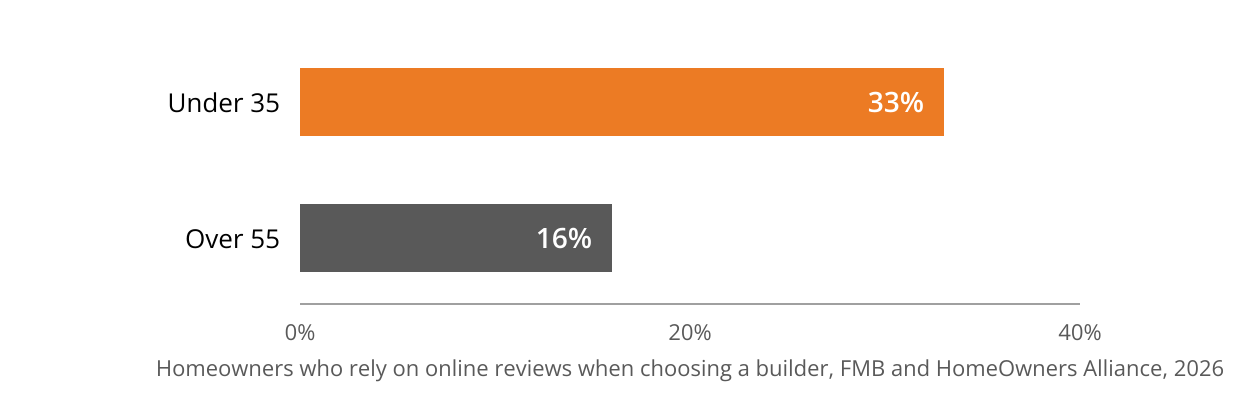
The FMB published that finding as a warning, because reviews can be faked and cowboys know it. Read from the side of a builder who does the job properly, it is an opportunity. Every genuine, recent review with a real reply under it is the thing a rogue trader cannot easily copy.
What the stars do to the money you already spend
Reviews earn their keep twice.
First, they help you show up. Google says local results are mainly based on relevance, distance and popularity, and that “more reviews and positive ratings can help your business’s local ranking” (Google Business Profile Help). Two builders the same distance from a homeowner, offering the same work, are separated partly by their reviews.
Second, they turn clicks into calls. Picture the same Facebook ad run by two firms. One lands a homeowner on a profile with forty recent reviews and a reply under each. The other lands them on three reviews from 2021. The ad and the budget are identical; the chance of the phone ringing is not. Everything you spend on advertising is trying to get someone to that moment, and the reviews are what they judge you on when they arrive. We covered the rest of the profile in Google Business Profile for builders; this is the part that does the persuading.
How to get more genuine reviews
The good news is that none of this takes a marketing budget. It takes a habit.
Ask at handover, in person. The day a job finishes is the day the customer is happiest with you. Ask then, face to face, before the invoice lands and before life moves on.
Make it one tap. Your Business Profile gives you a direct review link and a QR code. Text the link the same evening, or have the code on a card you leave behind. Every extra step loses people.
Ask everyone, not only the ones you expect to be glowing. This matters more than it sounds, for reasons in the next section.
Reply to every review. Thank the good ones by name and mention the job. Answer a poor one calmly and say what you did about it. Google notes that helpful replies help a business stand out, and a homeowner reading a fair answer to a complaint often trusts you more for it.
Keep them coming. A steady few every year reads better than a burst in one month and nothing since. Recent reviews tell a homeowner you are still trading and still doing it well.
The shortcut that is now illegal
Searches for “buy google reviews” are among the fastest rising around Google reviews in the UK, up 250% over the past twelve months (Google Trends, GB, retrieved 24 September 2026). Here is why that is a bad idea.
Since April 2025, fake reviews have been a banned practice under the Digital Markets, Competition and Consumers Act 2024. The Competition and Markets Authority can now fine a business up to 10% of its global turnover, and opened five investigations into fake and misleading reviews in March 2026 (CMA).
The rules reach further than buying reviews. The CMA’s guidance says that simply emailing customers to ask for a review is fine, but that encouraging only your satisfied customers to leave one can count as cherry picking, and any review you pay for or reward must be clearly labelled as such (CMA208, April 2025). Google’s own policy goes further still: no incentives of any kind in exchange for a review, and no selectively asking happy customers only (Google Maps content policy).
So the honest route is also the only safe one. Ask every customer, reward nobody, and let the work speak.
Where we come in
We set your profile up properly, including a simple way for you to ask every customer for a review at handover, and then we run the Facebook and Instagram campaigns that send homeowners to it. The two are built to work together: the campaigns bring people to your profile, and the reviews give them a reason to call.
If you are running ads to a profile with a handful of old reviews, or not running ads because you are not sure your profile would hold up, get in touch. We will look at what a homeowner sees today and tell you plainly what would change it.